

We are committed to meeting the Regulator of Social Housing’s Social Customer Access to Information Requirements (STAIRS) standard relating to transparency, influence and accountability of the information we share. This page provides clear information about how we manage our homes, deliver services, keep customers safe and ensure accountability. We review and update this information regularly to ensure our published documents remain accurate, accessible and compliant with the Social Housing publication scheme.
Social Tenants Access to Information Requirements (STAIRS)
STAIRS (the Social Tenants Access to Information Requirements) is a new government initiative that social housing providers must follow to ensure that customers can easily access information about homes and services.
What STAIRS means for you
STAIRS is designed to help you:
- Understand how your home is managed
- See how decisions are made
- Understand how your landlord is performing
- Ask questions and receive answers
- Hold Cobalt to account.
It is being delivered in two phases:
- Phase 1
- October 2026: publish key information about how we manage homes. You will find this information below.
- Phase 2
- April 2027: customers will be able to request specific information related to housing and housing associations must respond within 30 days of receiving the request.
We are a registered provider of social housing, providing homes, services and support to customers. We work with partners to improve neighbourhoods and deliver safe, well‑managed homes.
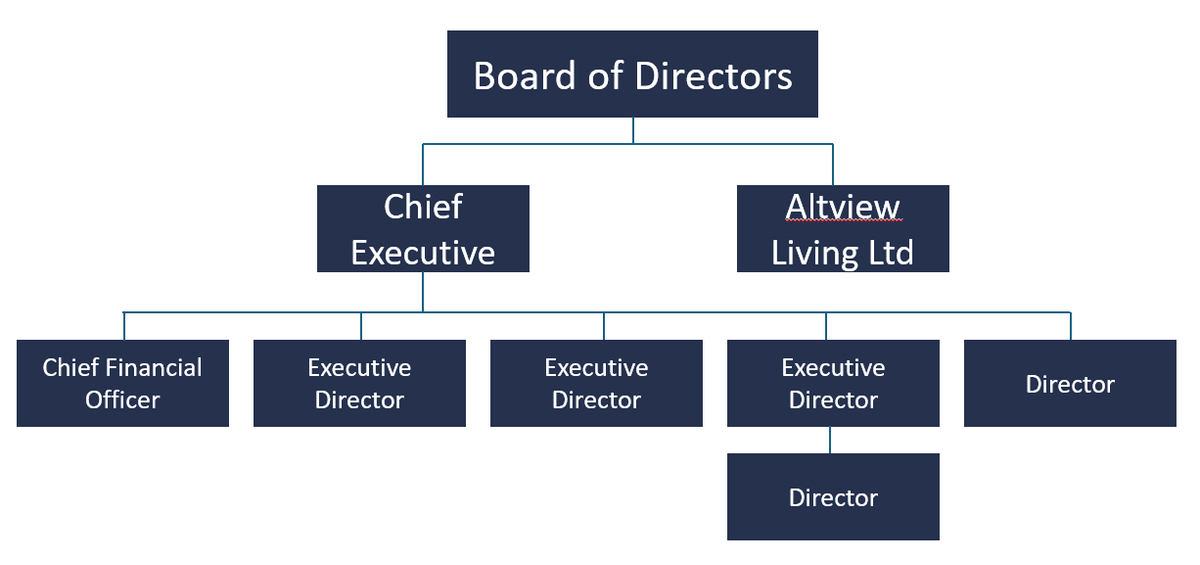
Cobalt Housing is governed by a Board of Directors responsible for strategy, risk and regulatory compliance. You will find details of our Board here. The Chief Executive is accountable to the Board and leads operational delivery, supported by a Senior Management Team covering:
- Housing and customer services
- Assets and compliance
- Finance
- ICT
- Corporate services – governance and assurance, human resources, marketing and communications and transformation.
You will find details of our Senior Management Team here.
Our governance framework ensures accountability to customers by requiring regular reporting on service performance, safety, complaints, customer feedback and engagement outcomes.
Organisational structure
Altview Living is a wholly owned subsidiary used only for VAT arrangements; it has no operational role and does not provide any services to customers.
Board committees
Board committees include:
- Audit & Risk Committee
- Customer Committee
- People & Remuneration Committee
- Investment & Development Committee
You can read more about our Board committees here.
How we make decisions
- Board:
Sets strategy, approves key policies, oversees risk and compliance and receives assurance on performance and safety.
- Chief Executive and Senior Management Team:
Make organisational and operational decisions within the Board‑approved framework.
- Managers and operational teams:
Deliver day‑to‑day services in line with policies and procedures.
We publish:
- Annual reports (click to find our latest and previous annual reports)
- Financial statements (click here to find our latest financial statement)
- Board and committee membership (click here to find details about our Board and committee membership)
- Regulatory judgements and notices (click here to read our latest judgement)
- Key governance information on our website so customers can see how decisions are made and how we are performing.
High-level organisational chart
We manage approximately 6,000 across North Liverpool and surrounding areas, including general needs, supported housing and leasehold properties. We publish the total number of homes we own and manage each year in our annual report. Click here to read our latest annual report.
Our approach to maintaining homes
We take a planned and responsive approach to maintaining our homes. This means we:
- Assess the condition of our homes through surveys, inspections and ongoing monitoring
- Prioritise investment based on safety, building conditions, legal requirements and value for money
- Plan major works such as roof replacements, external works and energy efficiency improvements
- Carry out day‑to‑day repairs to keep homes safe, secure and in good condition
- Communicate with customers when planned works are confirmed and explain what to expect
- Provide clear routes for customers to report repairs and raise concerns.
Repairs
Our repairs policy explains:
- How customers can report repairs
- Expected timescales
- What is included in responsive repairs
- How we keep customers informed.
Click here to read our repairs policy.
We publish high‑level repairs performance information. Click here to read our latest performance.
Planned maintenance and major works
We publish high‑level information about:
- How we plan and prioritise major works
- How we decide which homes receive investment
- How we assess building conditions
- How we communicate confirmed works to customers.
Click here to read about planned works.
We do not publish detailed schedules, contractor programmes or block‑level plans, as these contain sensitive and operational information.
Building safety compliance
We publish high‑level information about how we meet key safety requirements, including:
- Gas safety
- Electrical safety
- Fire safety
- Water hygiene
- Lift safety
- Building safety risk management
Click here to read about how we keep customers safe.
We explain how customers can raise safety concerns and how we respond to them. We do not publish statutory registers or building-specific compliance documents.
Our approach to asset management
We take a strategic approach to long-term investment, building condition and energy efficiency. We do not publish our detailed asset management strategy or stock condition data. We publish high‑level information on our website so customers can understand how we manage and invest in our homes.
We ensure our services are accessible, inclusive and responsive to the diverse needs of all customers and prospective customers. Our approach is grounded in understanding individual circumstances, tailoring communication and support, and using customer insight to shape service delivery. We publish clear, accessible information to help customers understand how to use our services.
Description of services
We provide clear, accessible and comprehensive information about all landlord services. This ensures customers and prospective customers understand their rights, responsibilities and the services available to them, and can hold us to account for the quality of delivery of these services. We provide a range of housing and neighbourhood services, including:
- Repairs and maintenance
- Tenancy management and support
- Anti‑social behaviour case management
- Neighbourhood management
- Customer services and enquiries
- Complaints handling
- Building safety and compliance checks
We provide multiple ways for customers to communicate with us and ensure information is readily available in formats that meet individual needs. Customers receive clear information at sign-up about how to access services through our Customer Business Hub, online services and housing teams.
Click here to read about the services we provide.
We publish high‑level service standards, so customers know what to expect, including:
- how quickly we aim to respond
- how we communicate updates
- how we handle complaints and concerns
- how we keep homes safe and well‑maintained.
We measure performance through:
- Customer Satisfaction Measures (TSMs)
- repairs performance
- ASB and neighbourhood service indicators
- complaints performance
- safety compliance reporting.
We publish high‑level performance information so customers can see how we are doing and where we are improving. Click here to read our latest performance information.
Service charges
Some of the services we provide are funded through service charges. We publish high‑level information about what these services cover, such as cleaning of shared areas, grounds maintenance, communal utilities and other building‑related services.
We do not publish detailed financial breakdowns, block‑level costs or individual service charge schedules, as these contain personal data and commercially sensitive information. Instead, we provide clear, customer‑friendly information about how service charges work and how we set them.
Our Rent & Service Charge Policy explains:
- what services may be included
- how charges are calculated
- how we consult with customers and leaseholders
- how to raise questions or concerns
Click here to read our Rent and Service Charge Policy.
Customer‑facing policies
We publish the policies that directly affect customers, including:
- Repairs policy
- Tenancy policy
- ASB policy
- Complaints policy
- Lettings and allocations approach
- Neighbourhood management approach (high-level)
- Rent Payment and Arrears policy
- Access to Housing Policy
Click here to find all our published policies.
Customers’ rights
We publish clear, high‑level information about customers’ rights under the consumer standards. This includes the right to:
- live in a safe, well‑maintained home
- receive clear, accessible information about services
- be treated fairly and with respect
- influence and shape services through feedback, engagement and scrutiny
- make complaints and have them handled in line with the Housing Ombudsman’s Code
- request information about services and decisions that affect them
- ask for reasonable adjustments if they need support accessing our services
We explain how customers can get involved, how they can raise concerns, and how they can request support or alternative formats. We provide clear routes for customers to request information about services so they can understand how decisions affect them.
Tenancy types
We offer a range of tenancies, including:
- Protected Assured – former Liverpool City Council customers
- Assured – standard tenancies for most customers
- Starter – issued to all new customers
- Market Rented – small portfolio of homes acquired without grant-funding
- Rent to Buy – 5-year term before purchase option
- Shared Ownership – aligned with Homes England funding.
Lettings and allocations
Cobalt’s Access to Housing Policy is available on our website, alongside clear policies relating to tenancy management and preventing unnecessary evictions. Our Tenancy Policy sets out the types of tenancies we offer, the customer groups they apply to and the circumstances in which they are granted. As the majority landlord in our core neighbourhoods, we recognise the importance of ensuring that tenure agreements reflect our range of homes, customer needs and the limited availability of social housing.
Click here to read about allocations and lettings.
Click here to read our Access to Housing Policy.
Changes to tenancies
Sometimes a customer’s circumstances change, and our Tenancy Policy sets out where Cobalt may offer another tenancy, including for relationship breakdown or cases where a household member is left in occupation following the death of the customer and where no succession rights exist.
Our Left in Occupation Policy provides an additional layer of support and discretion. Cobalt considers individual needs and vulnerabilities when assessing discretionary succession or assignment requests.
Cobalt subscribes to House Exchange, one of the largest national mutual-exchange platforms. Membership is provided free of charge to all socially rented customers. Anyone interested in a mutual exchange can register online at no cost.
We provide regular drop-in surgeries at our main office and within local communities to support applicants and customers. Support is available for customers who are not digitally confident, do not have access to Wi-Fi or a computer and to those needing help navigating House Exchange or completing registrations.
As part of the mutual-exchange procedure, all homes are visited to assess their condition and suitability.
We don’t own any high-rise or higher-risk buildings, so we don’t have a separate Building Safety Policy. Instead, we manage building safety through our key compliance areas, including gas safety, fire safety, electrical testing, asbestos management, and other statutory checks.
We publish general safety information so customers can understand the basics of how we keep homes safe.
Click here to find all our published policies.
Fire safety
We publish high‑level fire safety information. We do not publish fire risk management strategies, fire risk assessments or action plans.
Click here to read our fire safety information.
Customer engagement on safety
We give customers clear information about safety in their homes. This includes how we share important safety updates and how customers can contact us if they have concerns about gas, fire, electrical or other compliance areas.
Compliance checks
We publish high‑level compliance information for:
- Gas safety
- Electrical safety
- Fire safety
- Water hygiene
- Lift safety
- Damp and mould
We explain how we monitor compliance performance and take action where improvements are needed.
Click here to read our latest compliance performance.
Legal registers and building‑specific documents
STAIRS does not require landlords to publish statutory or operational registers. We therefore do not publish:
- Asbestos registers
- Fire risk assessment registers
- Gas servicing registers
- Electrical testing registers
- Lift inspection registers
- Water hygiene records
- Any building‑specific compliance documents
These contain sensitive information and are used internally to ensure safety and compliance.
We publish high‑level performance information so customers can understand how we are performing across key services and where we are improving.
We provide clear routes for customers to access this information on our website.
Click here to find our latest performance information.
Customer Satisfaction Measures (TSMs)
We publish our TSM results each year, including:
- overall satisfaction levels
- key themes raised by customers
- areas where we are performing well
- actions we are taking to improve services
Click here to find our latest Customer Satisfaction Measures.
Complaints and Housing Ombudsman
We ensure all customers can raise complaints easily, safely, and without barriers. A triage process is used to confirm the complaint with the customer and understand their desired outcomes. We publish high‑level information about complaints, including:
- number of complaints
- main categories
- response times
- learning and service improvements
- our Housing Ombudsman Complaint Handling Code self‑assessment
We explain how customers can escalate complaints to the Housing Ombudsman if they remain unhappy.
Click here to read our complaints process.
Click here to see our latest complaints performance.
Repairs performance
We publish high‑level repairs performance information, including:
- responsiveness
- completion rates
- communication standards
- themes from customer feedback
This helps customers understand how we are performing without publishing operational targets or contractor data.
Click here to read repairs performance in our latest annual report.
Safety compliance performance
We publish high‑level compliance information for:
- gas safety
- electrical safety
- fire safety
- water hygiene
- lift safety
We also publish high‑level updates on progress against key safety actions.
Click here to read our compliance performance in our latest annual report.
ASB and neighbourhood performance
We publish high‑level information about:
- ASB case outcomes
- partnership working
- support provided to customers
We do not publish case‑level ASB information.
Click here to read ASB performance in our latest annual report.
Tenancy management performance
We publish high‑level information about:
- tenancy sustainment
- tenancy turnover
- support provided to help customers maintain their tenancy
Evictions
We publish information about evictions, including the total number each year and the main reasons, where this information is already made public. Our approach focuses on prevention and support, and we work with customers to help them sustain their tenancy wherever possible.
We provide early intervention, support and advice to customers who may be at risk, and we only use legal action as a last resort.
Responding to performance issues
If performance drops in any area, we review the issue, work with teams or contractors to improve standards, and take further action where needed.
We explain where performance has been used to identify issues, strengthen services and improve outcomes for customers.
We publish high‑level information about improvements so customers can see how services are being strengthened.
Regulatory judgements
We publish high‑level information about any regulatory judgements or notices issued by the Regulator of Social Housing. This includes:
- whether Cobalt currently has a judgement or notice
- the type of judgement
- a plain‑English explanation of what it means
- a link to the Regulator’s published judgement
- high‑level improvement actions, if required.
Click here to find our latest regulatory judgement.
Service standards
We publish high‑level information about the standards customers can expect from our key services, including repairs, ASB, neighbourhood services, customer contact and tenancy management. These standards explain:
- how quickly we aim to respond
- how we communicate updates
- how we handle concerns or complaints
- how we keep homes safe and well‑maintained.
Click here to find out more about each service and its standards.
We measure performance through high‑level indicators such as Customer Satisfaction Measures (TSMs), repairs performance, ASB case outcomes, complaints handling and safety compliance. We publish this information so customers can see how we are performing and where we are improving.
Customer voice and influence
We provide a wide range of meaningful opportunities for customers to influence services, shape decision-making and participate in governance. Our approach ensures customers can engage in ways that suit their interests, circumstances and experience, including:
- taking part in surveys and consultations
- joining engagement activities or customer panels
- providing feedback on services
- raising issues or concerns
- helping shape improvements through scrutiny and challenge.
Click here to see the different ways customers can get involved.
We publish high‑level outcomes from customer feedback, including themes raised and the actions we take in response. This includes You Said, We Did updates so customers can see how their views influence services.
Click here to read the latest You Said We Did examples.
We do not publish minutes of customer meetings or case‑level information, as these contain personal or sensitive data.
We explain how customers can request further information about engagement or performance if they want to understand more about how decisions are made.
We provide information about how we manage neighbourhoods and support the communities where our customers live.
Our neighbourhood housing teams work across North Liverpool and surrounding areas to help keep communities safe, clean and well-maintained. They work with customers to address local issues and improve neighbourhoods.
We explain how customers can report concerns such as:
- Anti-social behaviour (ASB)
- Fly-tipping and litter
- Environmental issues
- Community safety concerns.
We work with partners, including the local authority, police and community organisations, to help resolve neighbourhood issues.
We also support local communities through activities such as:
- Customer and community events
- Neighbourhood walkabouts
- Community projects
- Partnership initiatives.
We publish information about the results of this work so customers can see how neighbourhood services are performing and how we are supporting local priorities.
We explain how we monitor neighbourhood services, measure performance and make improvements where needed. We also provide information on how customers can request further neighbourhood-related information.
To protect privacy and sensitive information, we do not publish details of individual ASB cases, confidential partnership information or detailed project plans. Instead, we provide clear summaries of how our neighbourhood services operate and the support available to customers and communities.
We work with contractors and suppliers to deliver services such as repairs, maintenance, cleaning, compliance checks and neighbourhood support. We do not publish commercial contract information, procurement processes or contractor performance data. Instead, we provide high-level information about how we make sure services are safe, good quality and offer value for money. We check that contractors meet legal and safety requirements and we monitor performance. Customers can contact us if they want to understand more about how services are delivered.
Accessibility and reasonable adjustments
We want all customers to be able to access our services easily. We publish information about how to request reasonable adjustments and how we support customers with accessibility needs.
We provide clear routes for customers to access this information on our website and through our customer business hub.
Customers can ask for reasonable adjustments if they need help using our services. This can include things like:
- different ways of contacting us
- longer appointment times
- support with forms or written information
- alternative formats such as large print or easy‑read
- communication preferences
- help to understand letters or decisions.
Customers can contact us in a number of ways, including in person, online and over the phone.
We provide clear routes for customers to:
- Raise issues or concerns, including repairs, ASB, safety worries or tenancy queries
- Make complaints, with information on how we handle them and how to escalate to the Housing Ombudsman
- Request information about services or decisions that affect them
- Ask for reasonable adjustments or alternative formats if they need support accessing our services
- Access urgent help, such as reporting emergency repairs
Click here to find all of the ways to contact Cobalt.
Accessibility and reasonable adjustments
We want all customers to be able to access our services easily. We publish information about how to request reasonable adjustments and how we support customers with accessibility needs.
We provide clear routes for customers to access this information on our website and through our customer business hub.
Customers can ask for reasonable adjustments if they need help using our services. This can include things like:
- different ways of contacting us
- longer appointment times
- support with forms or written information
- alternative formats such as large print or easy‑read
- communication preferences
- help to understand letters or decisions.